Executive summary
- Client: an enterprise software company whose field reps run long, structured discovery conversations with prospective customers before proposing a system change.
- Problem: turning one discovery assessment into a proposal took a rep 5 to 12 hours. Quality varied widely by rep, and the evidence behind each proposal lived in handwritten notes.
- What we built: a conversation intelligence platform that records discovery conversations with consent, suggests questions in real time, scores the rep's adherence to the discovery method, and extracts structured evidence with the exact quote attached. It produces process maps, quantified financial impact, and an executive summary.
- Status: working platform and executive demo built. A field-ready release for an initial group of about 15 reps is in contracting, staged in one-party-consent jurisdictions first.
- Why it matters: every conversation becomes structured, attributable data that can be added up across the whole sales force.
The problem
This company sells complex operational software with a sales cycle of 6 to 12 months. Before proposing anything, reps run a structured discovery assessment with the prospect's department heads: how work gets done today, where it breaks, and what that costs.
The method works when a strong rep runs it. At scale, three things break:
- Consolidation is slow. After the interviews, a rep spends 5 to 12 hours turning notes into a proposal.
- Quality depends on the rep. Some reps follow the method closely. Others skip steps, and the proposal gets thinner as a result.
- Evidence is anecdotal. A proposal that says "the service department loses hours to double entry" is more convincing when it quotes the service manager saying it, with a figure attached.
What we built
Capture
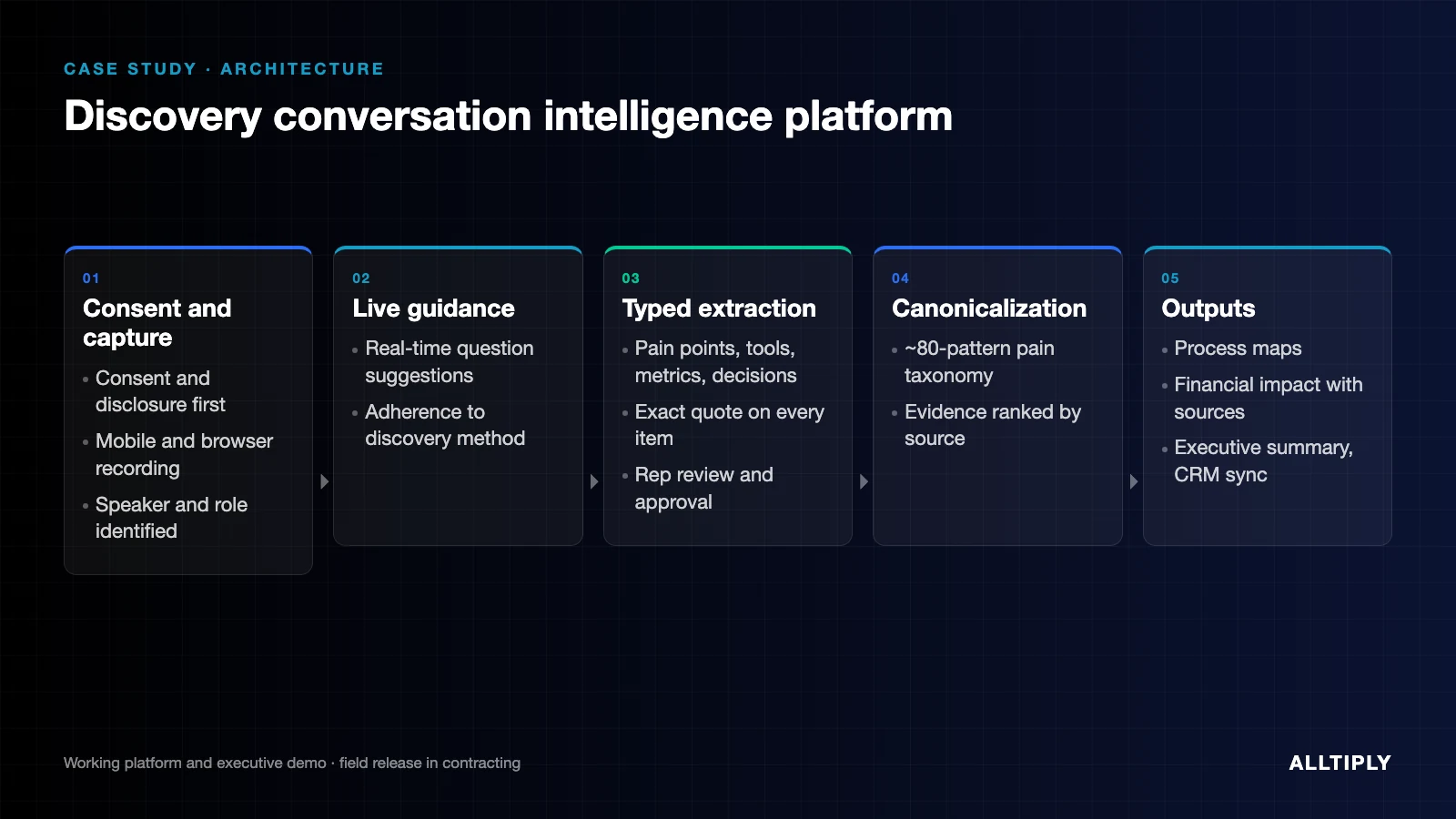
- Consent capture before recording starts, with customer disclosure built into the workflow. Every step has a timestamped audit trail.
- Mobile-first and browser recording, with diarized transcription that identifies each speaker and their role.
- Context attached at capture time: department, stakeholder role, territory, rep, and deal stage. Adding context at capture is what makes it possible to aggregate conversations later.
Guidance during the conversation
- Real-time question suggestions based on what has and has not been covered yet.
- Adherence scoring against the company's discovery method, so reps and managers can see which steps were skipped.
Structured extraction
- After each conversation, the AI produces typed objects rather than a summary: process steps, pain points with severity, tools and vendors mentioned, stated metrics and financial impacts, claims, and decision points.
- Every object carries the exact quote it came from and a confidence score, and goes to the rep for review and approval.
- Pain points are mapped to a governed taxonomy of about 80 patterns. "We re-key service tickets" and "we type it twice" become one countable pattern with two pieces of evidence.
- Evidence is ranked by source: customer-stated first, industry benchmark second, rep-stated third.
Outputs
- Current-state process maps, generated from the conversation and then standardized.
- Quantified financial impact, built from stated ranges and rates, with each figure linked to its source.
- An executive summary for the prospect's leadership, and proposal-ready evidence with attribution.
- Integration with the company's CRM, so the output lands where the deal is managed.
The executive layer
An executive view adds conversations up across the sales force: pain points ranked by how many accounts mention them, competitor mentions per 100 conversations, and regional comparisons. Every aggregate has a minimum-evidence rule (for example, at least 40 conversations and two supporting quotes) before it is shown. Every number links back to the quotes behind it. The architecture is covered in From conversation to executive instrument.
Designing for consent and trust
Recording customer conversations raises legal and relationship questions that do not come up in most AI projects. Consent rules vary by jurisdiction, and some customers do not want to be recorded at all. The pilot was designed to start in one-party-consent jurisdictions, keep customer disclosure explicit, and support manual entry for conversations that are not recorded, so reps can still complete the assessment when a customer declines.
What was hard, and what we would do differently
- Legal review sets the timeline. Any project involving recording and consent should budget extra time for legal review before assuming a contract date.
- Scope grows naturally. Once stakeholders saw the discovery platform, they wanted it to cover adjacent parts of the sales cycle. Each phase needs a deliberate decision about what is in and what comes next.
- Build on the client's own AI capabilities where they exist. The client was developing its own conversation AI features. The platform positions itself as the discovery-specific layer that can use those features for transcription, rather than competing with them.
- Short, dense working sessions work well. Getting the sponsor, a senior sales leader, and the owner of an earlier internal prototype in the same working sessions settled in days what would normally take weeks of requirements back-and-forth.
What was multiplied
The best reps already ran great discovery conversations. The platform brings every rep closer to that standard and cuts proposal assembly from hours to a review step. It also turns each conversation into data the whole company can use: product, pricing, and leadership can see what prospects actually say, backed by quotes.
Related
Want this for your sales team? Talk to us.
Related service: Conversation Intelligence.