Executive summary
- Client: a media company that programs, distributes, and reports on streaming channels for content partners.
- Problem: the streaming business ran on a general-purpose work-management board, spreadsheets, a separate billing system, and manual monthly reports built from several streaming platforms. Nothing connected clients, platforms, vendors, contracts, schedules, and revenue.
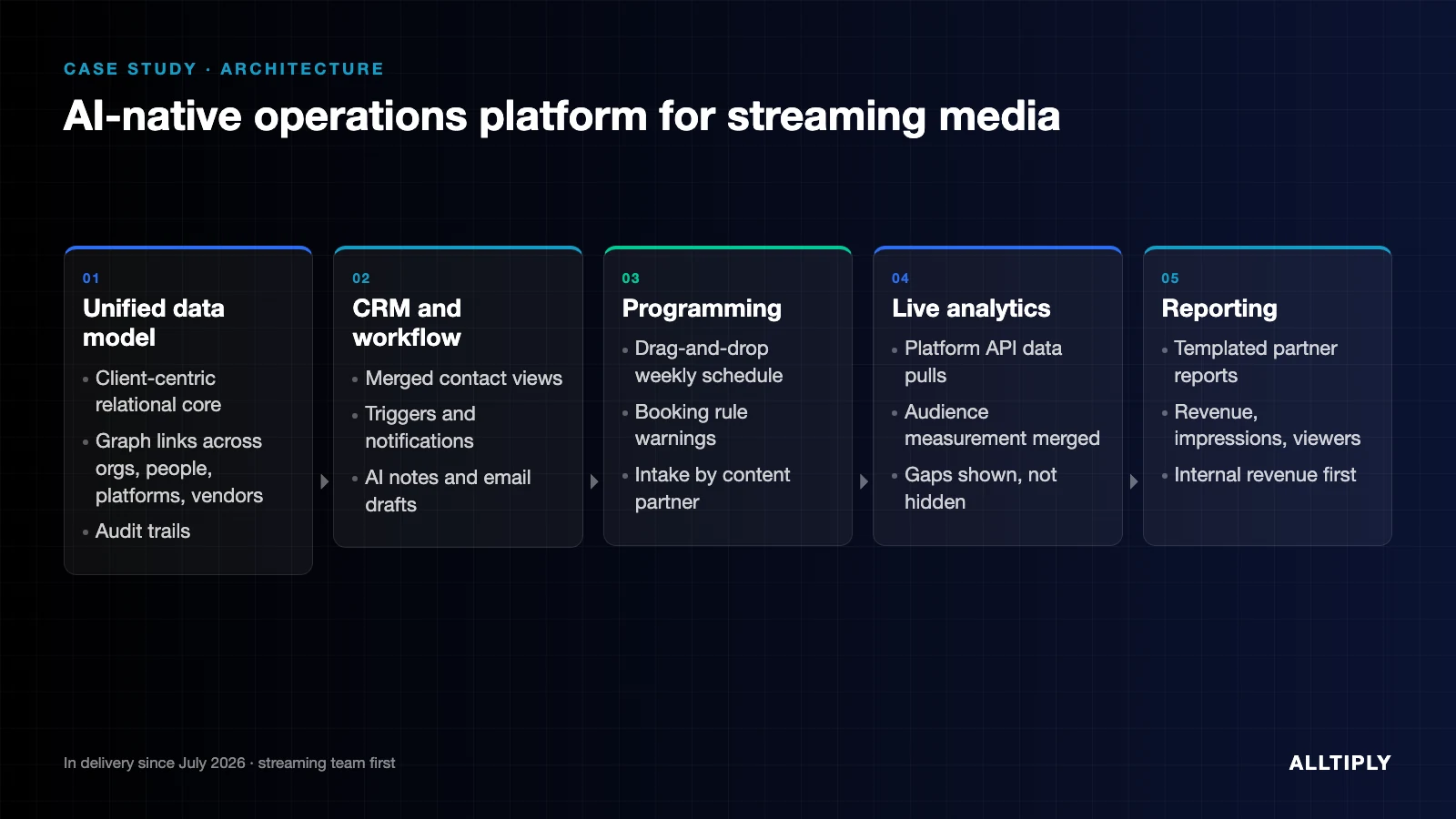
- What we are building: an AI-native operations platform with a unified data model covering CRM, programming schedules, content intake, workflow automation, and live analytics pulled directly from distribution platforms.
- Status: in delivery since July 2026, rolling out in phases to the streaming team first.
- Design goal: one system of record that can carry the business for the next three to four years without another rebuild.
The problem
A streaming channel business has more moving parts than it looks like from outside. Every week the team has to collect new episodes from content partners, check licensing restrictions, build a programming schedule under rotation and repetition rules, fill gaps with archived content when deliveries run late, adjust ad placement, and publish schedules on a fixed weekly deadline. Every month, content partners expect reports on revenue, impressions, and viewers.
At this company, that work was spread across tools that did not talk to each other:
- A general-purpose work-management board with a separate sub-board for every platform and client.
- A spreadsheet checklist for weekly programming.
- A separate billing system with its own view of clients.
- Analytics exported by hand from several streaming and distribution platforms, some of them delayed and missing impression data.
Each monthly partner report meant pulling files from several places and building slides by hand. Contact details, contracts, and workflow status for the same partner lived in different places.
What we are building
A data model built for the business
- A client-centric relational database that extends the data model the billing system already uses, so the two stay aligned.
- A hybrid relational and graph design for the CRM. Organizations, people, platforms, and vendors can be linked in flexible ways, and documents and communications attach to whichever records they concern.
- Platform codes on each relationship, so the same partner can be tracked separately on each streaming platform it appears on.
- Role-based access, and audit trails on document and contract changes.
Programming and content intake
- Drag-and-drop weekly scheduling, with warnings when a booking breaks a rule.
- Support for both program types the team runs: weekly programs that air on set days, and inventory programs that repeat blocks of episodes over several weeks.
- Asset ID management, plus CSV import and export for the formats partners and platforms already use.
- An intake screen that organizes new deliveries by content partner and handles each partner's delivery pattern.
- Flexible manual editing first, with optional scheduling rules added later. The team asked for control before automation.
Live analytics and automated reporting
- Direct API connections to streaming and distribution platforms, replacing static exported reports with scheduled data pulls.
- Audience measurement data merged into the same model for more detailed viewership reporting.
- Templated partner reports covering revenue, impressions, and unique viewers, generated from the platform instead of assembled by hand.
- Internal revenue reporting was the first deliverable, chosen for the fastest payback.
Workflow and AI features
- Workflow automation with triggers, notifications, and a "My Work" view per person.
- AI note-taking and email drafting inside CRM records.
- Planned automation for content intake, schedule updates, feed management, asset tracking, and links to cloud file storage.
How we are rolling it out
Replacing a tool everyone already knows is mainly an adoption problem. The rollout is designed around that:
- Access starts with a small group, led by the operations lead who owns the process.
- Role-specific surveys go out before each round of changes, so feedback comes from each role, not just from the loudest voice.
- Video walkthroughs and meeting recordings, with transcripts, let people learn at their own pace.
- Weekly check-ins turn feedback into the next release.
- The streaming team goes first. Other business lines follow if it works.
Feedback is changing the product in specific ways: merging the organizations and people views into one, larger fonts, favorites for quick access, calendar views, client dashboards, and alerts for reactivations and uploads.
What we have learned so far
- Replicate the team's language before improving on it. The early data model used generic terms. Mapping it to the company's own vocabulary made reviews faster and cut down on misunderstandings.
- Data quality depends on the upstream sources. Some platform data arrives late or incomplete. The platform shows where data is missing instead of hiding it, and a planned change in distribution provider should close part of the gap.
- Performance counts toward adoption. A slow screen in week one does more damage than a missing feature. A database refresh was prioritized as soon as speed came up.
Related
Running your operations on tools that do not talk to each other? Talk to us.
Related services: Operational Dashboards and Reporting and AI System Integration.