Finding: when an AI system has been tuned for months and still is not reliable, a short, fixed-length rebuild on the same data, benchmarked against the current system, is often faster and more honest than more tuning. It only works if the comparison is agreed in advance and the rebuild is done with the internal team, not against it.
Summary
- Systems usually stall because of early structural choices, such as how documents are chunked, which embedding model is used, and how context is assembled. Prompt changes and parameter tuning cannot fix those.
- A three- to six-week rebuild on the same corpus gives a measurable answer: is the ceiling in the approach or in the data?
- The main risk is political, not technical. A rebuild that clearly beats a long internal effort creates a cost for the team that owns that effort.
- Agree on the benchmark method, question set, and date in writing before the rebuild is delivered.
Where this comes from
In early 2026 ALLTIPLY rebuilt a customer-facing help assistant for an enterprise software company in about three weeks, using the same documentation the existing system had been built on for months. The rebuild cut answer time from tens of seconds to 3 to 5 seconds and improved retrieval and answer accuracy on the benchmark questions. The project is described in the product help assistant case study. This paper covers the decision behind it: when to rebuild instead of continuing to tune.
Signs a system needs a rebuild
Consider a rebuild when most of these are true:
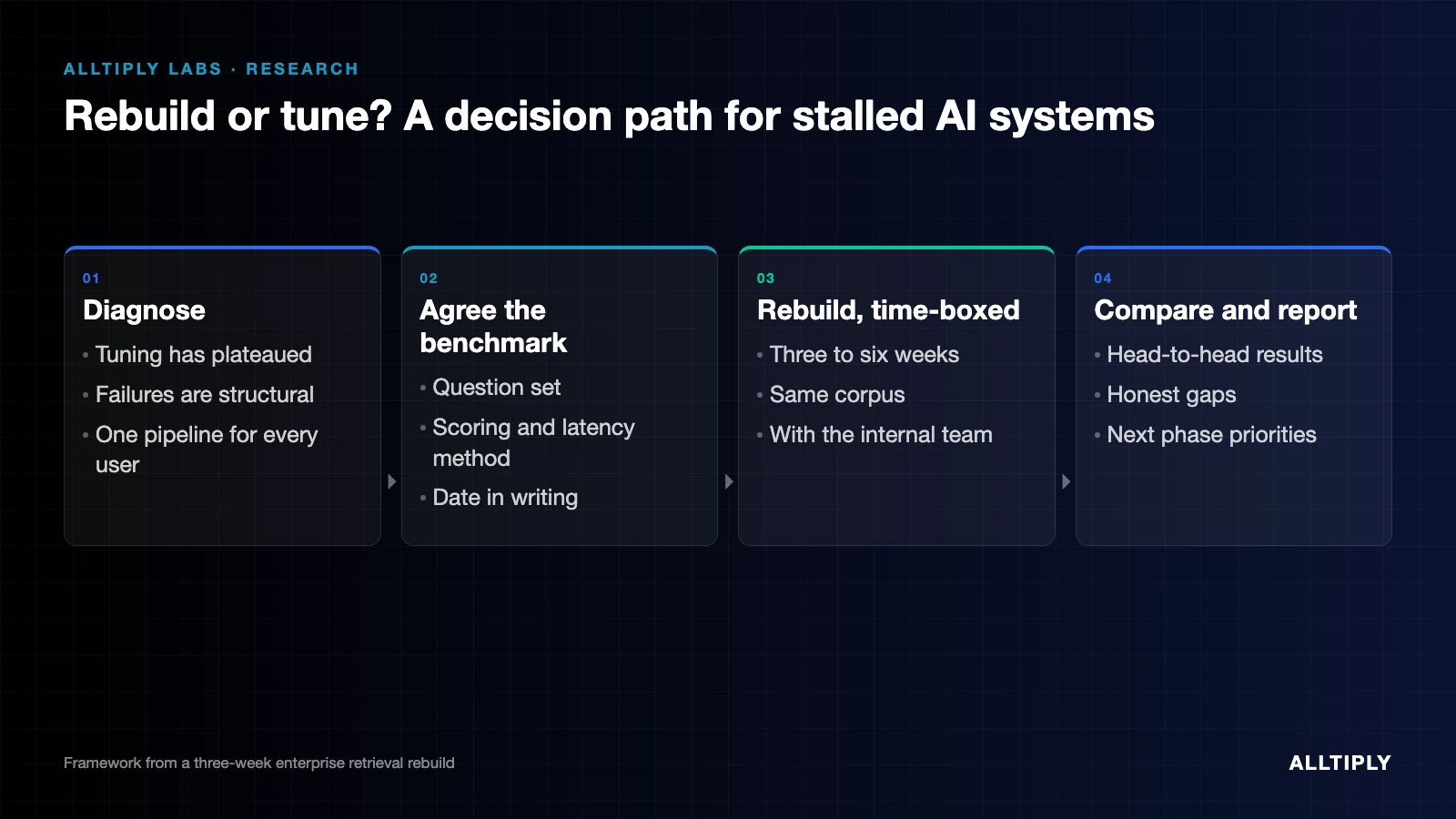
- Tuning has plateaued. Months of prompt and parameter changes have produced small, inconsistent gains.
- Failures are structural. Retrieval returns the wrong passages, not just poorly worded answers. Domain vocabulary such as product codes and internal names confuses the embeddings.
- One pipeline serves very different users. Deep technical users and quick-answer users get the same retrieval depth and answer length.
- Nobody can say what "better" means. There is no fixed evaluation set, so every change is judged by impression.
- The data is available. You can get the same corpus, logs, and representative questions the current system uses.
Keep tuning when failures are narrow and well understood, when a regression suite already exists and gains are steady, or when the problem has no measurable comparison, such as questions of tone or design preference.
How to run the rebuild
- Get access through a small, clearly scoped piece of work. Understand the current architecture properly before changing anything.
- Agree on the comparison first. Put the question set, scoring method, latency measurement, and benchmark date in writing before delivering anything.
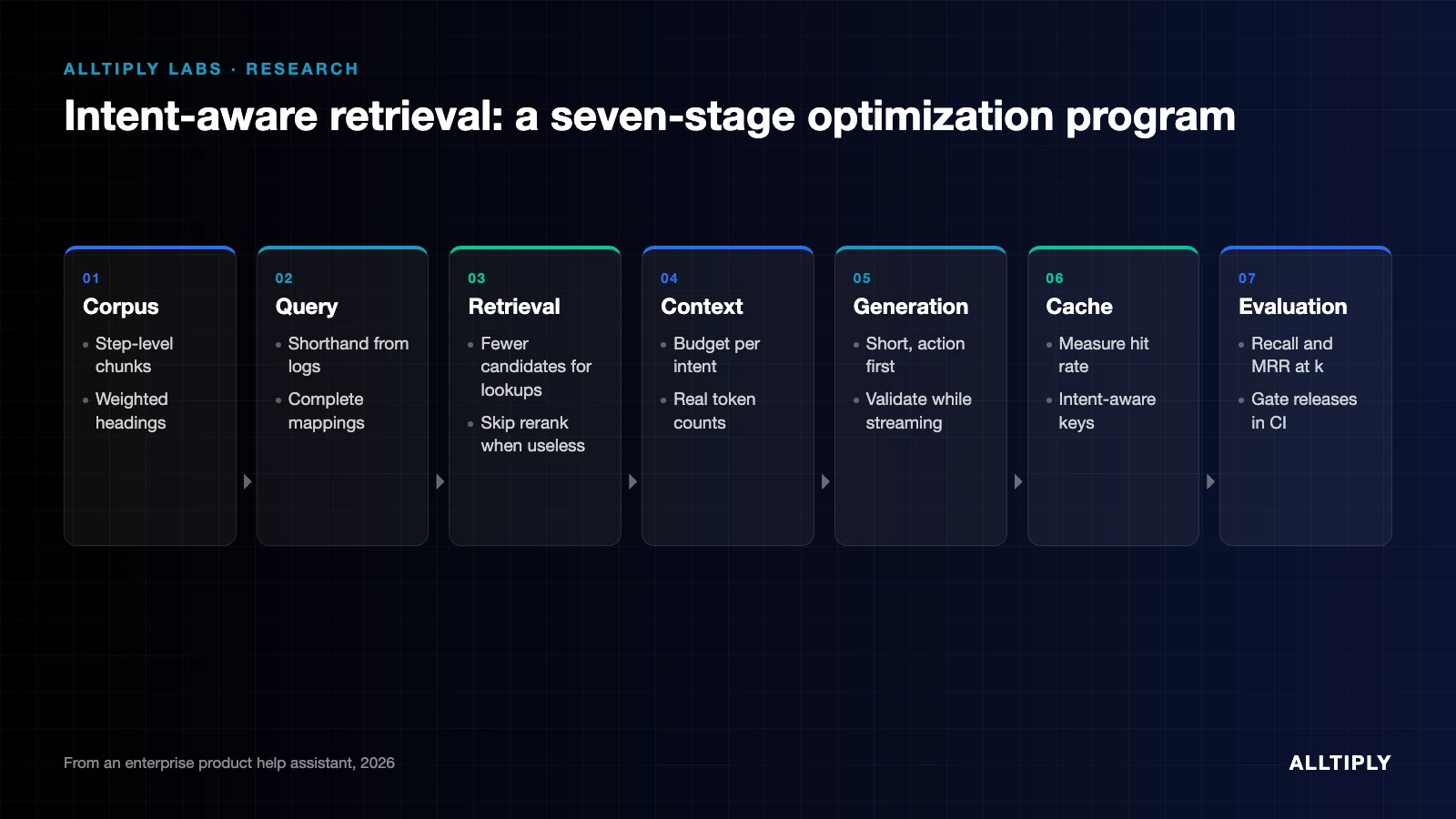
- Rebuild the parts that set the ceiling. Typically: chunking tuned to the domain's structure, domain-specific embeddings, a reranker, intent-aware retrieval, and a clear line between approved answers and generated ones (see Premium and fallback answers).
- Keep a fixed time limit. Three to six weeks. A rebuild without a time limit turns back into tuning.
- Report gaps honestly. Show where the rebuild still falls short. In our case, some product areas still had uneven quality, and that shaped the next phase.
The political risk
This is the part most technical write-ups leave out. When a short rebuild beats a long internal effort, the internal team can end up looking bad to its own leadership. That can stall or end the work regardless of the technical result. We have seen benchmarks postponed once the likely result became clear.
What reduces the risk:
- Build it with the internal team. Present the rebuild as adding to their work. Share the code, the evaluation set, and the credit.
- Lock the benchmark date in writing. Without a committed date, there is no guarantee the comparison ever happens.
- Tie the follow-on work to the executive sponsor's goals. Their objective is a working system, not defending a particular approach.
What you get either way
Even when a rebuild does not lead to a larger project, the organization learns where the ceiling actually is. For ALLTIPLY, the reusable lessons (fine-tuned domain embeddings, a custom reranker, intent-aware retrieval) carried directly into later work.
Method and limitations
This framework comes from one enterprise rebuild and ALLTIPLY's broader retrieval work. It is a practitioner's decision guide, not a statistical study. The three-to-six-week range assumes the corpus is available and a small, experienced team. Larger or messier data will take longer.
About ALLTIPLY Labs
ALLTIPLY Labs publishes what we learn from building AI systems that have to work in production. If your system has stalled, talk to us about a fixed-length rebuild with an agreed benchmark.